DDG-116 and DDG-1001

On April 7th 2018, Bath Iron Works, BIW, was hosting family day at the Bath Maine facility.  Not that I expected anything special, after all it was my Birthday – yeah, thanks BIW and US Navy folks!  Well, the real event included the opportunity to tour two new ships that were pier side – the USS Thomas Hudner DDG-116 and the USS Michael Monsoor DDG-1001.  Here my wife Lisa and I are aboard the USS Thomas Hudner on the left, and the USS Michael Monsoor on the right taking a photo op near the end of each ship’s tour.




It is such a privileged to be able to tour these ships and to see what remarkable products that BIW has built for the US Navy.  Obviously some areas of each ship was off limits, but the tour through the ship was simply amazing none-the-less.  It is reassuring to see that our Navy has some of the best damned equipment, and knowing that they will have these assets when called upon to use them.

Remembering the PDP-8

The PDP-8 was a mini-computer manufactured by Digital Equipment Corporation eons ago and introduced in its earliest configuration on March 22, 1965.  I was about to turn 5, and I likely had no clue what a computer was.

I was introduced to the PDP-8 in 1974 as a junior high student and wrote a few programs for a class that year.  This is also about the time I noticed girls more.  I wanted one, a computer, the girlfriends would have to wait another year.  

Move forward 6 years to my 3rd year of college and somehow that old PDP-8 from 1974 had made its way to the local university I was attending.  It was a chance encounter on my part as I took a different route through one of the campus buildings to kill some time.  In some isolated room, miles from the campus computer center, it continued to hum it’s merry way.  I never did find out what they were using it for, or when they got it.  I still wanted one.

After college, I did not expect to see a PDP-8 machine at all.  I went to work for a local software company, and, well, as luck would have it, I did have a chance to install our fuel oil billing software on a PDP-8 at an oil delivery company in 1985.  I would have still wanted one – all those lights flashing and panel switches.

 Move forward about 30+ years and one can procure a PDP-8 emulator and mini-replica based on the Raspberry Pi for example.  I’m wondering what I will do!!

Buyer Beware

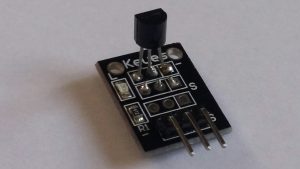
Incorrect placement of DS18B20 on PCB

Recently I had been testing a few discrete DS18B20 temperature sensors on a breadboard.  I eventually recalled that I had bought some temperature modules with the DS18B20, resistor, and LED already built in.  That’s what I wanted to use instead of discrete components for a quick script check.  I located the modules after a short search and it was apparent I had never looked at them closely as they were still in the sealed packaging.  Figures.  Well upon opening, I found the placement of the TO-92 on the PCB to be incorrect.  I took a closer look and realized that the module would not work as is and would have to be modified to work.   The small module had three locations for a TO-92, giving options on how the leads fed to the 3-pin connector.  The PCB traces were easy to see, so I snipped the TO-92 from the middle position, rotated it 180 degrees, moved it to the top position, and soldered it in place.  The untrimmed snipped off parts of the leads can still be seen here.

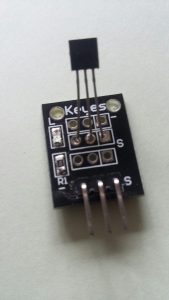
Corrected Version

I’ll trim them down some more later.

Operationally, that was a lot better.  Hooked them up to a NodeMCU ESP8266 running a LUA script and all was good, with the LED blinking during data line read/write cycles.  I’m off to see what other things await.

Update:  Added picture of item as it originally came from vendor.